Saturday, June 6, 2015

The Infinite Art Tournament, Round FOUR: Friedrich v. Gentileschi!


It's the first weekend of an even-numbered month!  Let's start a Fourth Round match!


Caspar David Friedrich
1774 - 1840
German
  • Wrecked Dame Elisabeth Frink's hopes in Round 1.
  • Unstrung Naum Gabo in Round 2.
  • Crushed Jean-Honoré Fragonard in Round 3.


Artemisia Gentileschi
1593 - 1652
Italian
  • Slew Gentile da Fabriano in his tent in Round 1.
  • Dispatched Théodore Géricault in Round 2.
  • Outpolled Jacques-Louis David in Round 3.


Vote for the artist of your choice in the comments, or any other way that works for you. Commentary and links to additional work are welcome. Fourth-round matches are open for at least three months after posting.

Friday, June 5, 2015

At the Movies: "Dune" and "Jodorowsky's Dune"

At the Movies with Michael5000


Dune
David Lynch, 1984.

imbd score: 6.6
Ebert: One Star
Rotten Tomatoes: 56% (!) Fresh


In 1984 I was a high school sophomore, living in a home without a television in a town far too small to have a movie theater, and I was nothing if not easily entertained. So, the most damning thing I can say about Dune is that even back then, when I saw it on the big screen on a trip to the Big City, I thought it was laughably bad. Rewatching it on the small screen recently was kind of fun, but it's the kind of fun that comes from witnessing the flowering of a classic fiasco. It's a bit like watching one of those YouTube "fail" compilations, but set in an alternative universe and made surreal by the occasional appearance of Patrick Stewart, Sting, and enormous sandworms.

The badness of Dune is fourfold. First, the film is paced as if it was intended to replicate Frank Herbert's novel scene for scene, until someone noticed that the first few chapters had taken up much of the length of a standard commercial movie. So, after a indulgently slow-moving set-up of the film's premise, the second half of the film turns into a frantic illustrated summary of events.

Second, the script is as expository as a medical textbook. Many reviews at the time and since have complained that the film was hard to follow, but it really isn't. The problem is that it didn't make paying attention worth the effort. But the political and social complexities of the Dune universe, such as they are, are explained in excruciating detail every step of the way. There is longwinded voice-over narration from a random minor character, and the characters' thoughts are forever being dubbed over close-ups of their pensive faces. These narrated thought-bubbles are kind of painful, or kind of hilarious once you get into the spirit of the thing, both for their inherent ham-handedness and as a sign that the director has given up even trying to make the movie work on the strength of acting and script.

Thirdly, the production budget seems to have been thrown around in a very uneven sort of way. As a science-fiction epic set in the distant future, Dune has a certain obligation to wow us with special effects. Occasionally it kind of does. Some of the set design does a great job of invoking a futuristic shabbiness that you might imagine pervading a galactic feudal society. But many of the visual effects are simply bad -- and I mean really, startlingly bad, uncomfortably reminiscent of the B-movie special effects of 30 years earlier. Like the screenplay, they get worse as the film goes on. To say that the climax battle scene is underwhelming is really putting it very gently.

Finally, this is a movie by David Lynch. He has made a great effort to distance himself from Dune -- I've read that interviewers must always promise not to ask him about it -- but his characteristic visual style is all over it. This gives Dune a certain cache for the kind of film buff who likes, or pretends to like, Eraserhead. Now mind you, I think there is a place for David Lynch in this world, and enjoy a little Blue Velvet as much as the next guy. But why anybody thought he would be a good choice to head up a science fiction spectacular is one of the great mysteries in the history of cinema.

Oh, there's actually a fifth thing. The film music was composed and performed by the rock group Toto, of "Africa" and "Hold the Line" fame. They delivered a mostly unremarkable score, but one that is augmented at dramatic moments by big guitar power chords. Like so much in Lynch's Dune, this is either kind of horrifying or a real hoot, depending on whether you are still rooting for the film or have decided just to sit back and enjoy the train wreck.

The bland pop noodlings over the closing credits are a bit of a horror, too.

Michael 5000's imdb rating: 3.


Jodorowsky's Dune
Frank Pavich, 2013.

imbd score: 8.1
Rotten Tomatoes: 98% (!) Fresh.


Me and Mrs.5000 have developed a taste for a very, very narrow genre of film: independent documentaries about spectacular moviemaking fiascoes. Not films about “The Making of [X]”; those tend to be promotional fluff that don’t actually tell you much about how movies are made. Films about failed projects, ironically, tend to give you more of a sense of the colossal stakes at play in film production. We learn from them that for a movie to happen, there is a vast community of creative and technical talents that must be recruited, organized, housed, fed, coddled, and browbeat, and a ghastly amount of money to be spent by people who have every reason to fear that they will never see any return on it if they let someone pursue an independent artistic vision. Really, the marvel is that movies ever get made at all.

For a lesson in the perils of filmmaking, it is hard to beat Lost in La Mancha, a 2002 documentary about Terry Gilliam’s failed project The Man Who Killed Don Quixote. With independent financing, an experienced director, a big-name star, and a lively concept, Gilliam’s project seems like a movie that could hardly help becoming a critical and popular hit. Then little problems start cropping up. Then big problems start cropping up. Then, in an astonishing sequence caught on video, a freak of nature wipes out the production, and millions of dollars worth of effort, in a matter of minutes.

Last year’s Lost Soul: The Doomed Journey of Richard Stanley’s Island of Dr. Moreau is about a movie that eventually got made, quite badly, after its original director was fired. There was money in the case, of course: personal issues exacerbated studio fears that Richard Stanley was too inexperienced to actually execute the big-budget project that he had developed. And this was probably a valid concern, but – well, have you ever actually ~seen~ The Island of Dr. Moreau? It is bad, weirdly bad, and whatever Stanley's weaknesses might have been it's clear that the ostensible fixer, veteran director John Frankenheimer, was wholly unable to exert a firm directorial hand. Lost Soul is a testament to the epic corrosive force of “personal differences,” and will strike a chord with anyone who has ever endured the joylessness of a toxic workplace environment.

This brings us to Jodorowsky’s Dune, a look back from forty years later at a legendary science fiction epic that never made it out of pre-production. It is hard to imagine Alejandro Jodorowsky's adaptation of Frank Herbert’s science-fiction bestseller really materializing the way he imagined it – with Salvador Dali (!) as the Galactic Emperor, for instance, with Orson Welles and Mick Jagger (!) as Harkonnen baddies, and his own son as the hero Paul Attreides, and sprawling out over an absurdly impractical running time. On the other hand, the sheer volume of talent he managed to wrangle into working on pre-production, largely by all appearances on the force of his mad-visionary personality, is pretty startling. And the tour of the storyboards that we get over the course of Jodorowsky’s Dune make it plentifully clear that, had it been made, it might have been amazing. Which raises the wistful question – what if it had been an intelligent science fiction spectacular that reshaped the film industry in the 1970s, instead of the dumb science fiction spectacular that actually was?

Of course, if it could have been amazing, it could also have been an embarrassment on the scale of, well, David Lynch’s Dune. I suspect it would have been. The thing about mad visionaries is that their vision is sometimes sabotaged by their madness. What makes Jodorowsky’s Dune fun to watch is the way it explores that tension between ambition and prudence, between daring to believe in your dreams and staying grounded in your reality. So, is Alejandro Jodorowsky’s adaptation of Dune a cinematic masterpiece that the world has lost, or is Alejandro Jodorowsky just an eccentric with delusions of grandeur and a cult following? These two things are not, of course, mutually exclusive.

Michael 5000's imdb rating: 7.


Also Mentioned:
  • Eraserheadimbd: 7.4.  Michael5000's provisional imdb rating: 2.
  • Blue Velvet imbd: 7.8.  Michael5000's provisional imdb rating: 7.
  • Lost in La Manchaimbd: 7.4.  Michael5000: 8.
  • Lost Soul: The Doomed Journey of Richard Stanley’s Island of Dr. Moreauimbd: 7.9.  Michael5000: 7.
  • The Island of Dr. Moreauimbd: 4.4.  Michael5000's provisional imdb rating: 2.
  • The dumb science fiction spectacular that actually was.  imbd: 8.7  Michael5000: 6.

Thursday, June 4, 2015

The Infinite Art Tournament, First Elimination Round #38/64


Faceoff #1: Van Doesburg v. Marin

Theo Van Doesburg
1883 - 1931
Dutch

Tied with William Dobson in his first try at the First Round, in December 2012.
Skunked by Ernst Haeckel in a second shot at Round 1.


-----

John Marin
1870 - 1953
American

Trampled by Franz Marc in Round 1.


Faceoff #2: Marini v. Masaccio

Marino Marini
1901 - 1980
Italian

Lost to John Martin in Round 1.


-----

Masaccio
1401 - c.1428
Florentine

Lost to Simone Martini in Round 1.


Vote for the two artists of your choice! Votes generally go in the comments, but have been known to arrive by email, by postcard, or in a sealed envelope.

Please note that you may vote only once in each face-off.  Opining that both of the artists in one of the two face-offs is superior to the other is fine, but casting your votes for two artists in the same face-off is not permissible.

Wednesday, June 3, 2015

The Wednesday Post


Recap of an American Roadtrip, part 2
Relax in Luxury


...in which we find out what's happening these days at the sites of the boring postcards of two weeks past!


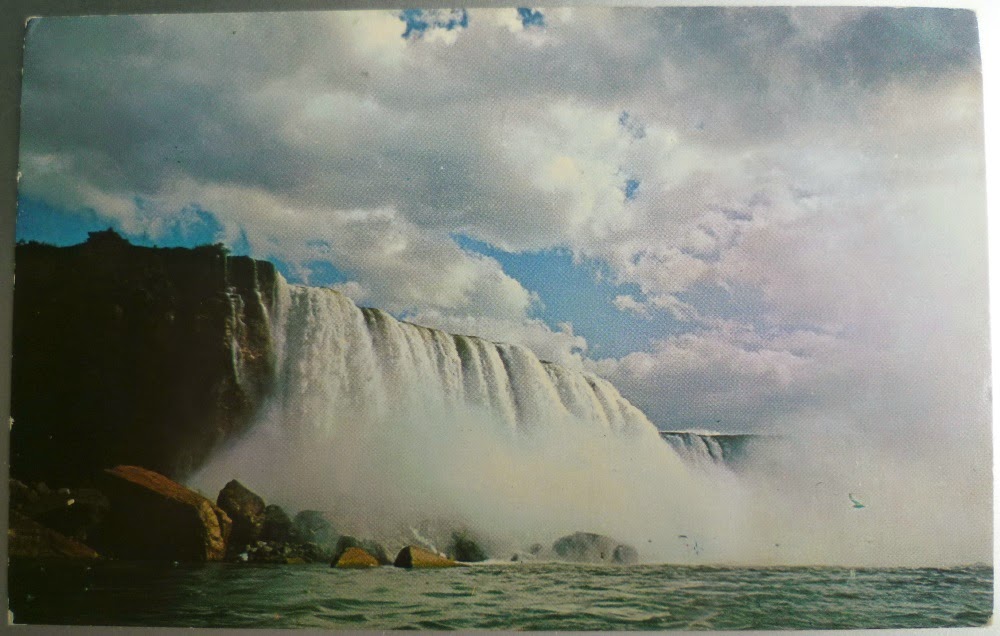
The Horseshoe Falls
NIAGARA FALLS, ONTARIO, CANADA


The Horseshoe Falls are still there.  I mean, duh.


NANCY HANKS LINCOLN STATE MEMORIAL
LINCOLN CITY, INDIANA


It's not explained on the original postcard, but Nancy Hanks Lincoln was Abraham Lincoln's mom.  She died in 1818 after the family cow got into a patch of the wrong plant, which poisoned its milk.  It sounds kind of exotic, but this kind of thing happened all the time back in the day, back before our lives were made so much worse by the arrival of abundant processed foods. 

Anyway, Ms. Lincoln's gravesite eventually became the Indiana State Memorial, it went Federal in 1966 and is now part of the Lincoln Boyhood National Memorial.  The memorial building shown on the postcard is still there.  At a glance, it probably has more historical interest as a quintessential WPA structure than for anything to do with Honest Abe.


THE "SINKS" AT LANDER, WYOMING


There's a place like this in Southern Oregon, too, where a river suddenly ducks underground for a while through an underground cavern.1  It's a pretty cool thing to see in person.  The Sinks at Lander are2 still there. 


CHINESE SUNKEN GARDEN IN BRACKENRIDGE PARK
San Antonio, Texas


The Chinese Sunken Garden is... well, it's kind of complicated.  It isn't, and wasn't, a Chinese Garden.  It's a Japanese Garden.  It was redesignated as a Chinese Garden in the early 1940s, what with the war fever.  It sounds like pure grandstanding, but the intent was apparently just to keep the place from being vandalized.  Once the Second World War was over, in 1984, the City of San Antonio formally re-renamed it the "San Antonio Japanese Tea Garden" at an event attended by dignitaries of the Japanese government, and then, over the ensuing years, slashed funding for its upkeep and pondered shutting it down.  These days, though, it has been bailed out by private-sector donors.  Thanks, San Antonio Parks Foundation!

After an alarming amount of time spent in research, I think that the current landscaping plan obscures the angle that the postcard photo was taken from.  But this gives you a pretty good idea of what the place is looking like these days.


Let's go with it is still there.


SHANGRI-LA MOTEL
6828 N.E. Union Ave.
Portland 11, Oregon


The Shangri-La no longer exists.  You can see some of its skeleton in apartments that look god-awful from MLK (Union Avenue, too, no longer exists)...


...but don't look quite as bad from the side street:


Far cooler than the postcard-future of the Shangri-La, however, is the postcard-past of the Shangri-La.  Behold!


This is found footage assembled by multimedia artist Mack MacFarland; I found it on the MLK in Motion blog.  I think it's great.


1 I sweated over this phrasing.  "Underground cavern" is redundant; however, "cavern" seems naked without the adjective.

2 The Lander Sinks is still there?  After all, "the Sinks" is a singular thing.  It's not like there are more than one "sink" there.  I went with are after realizing that I hadn't hesitated over American Falls are still there, even though American Falls is a single entity.  American Falls is still there.  American Falls are still there.  You make the call.

Tuesday, June 2, 2015

The Infinite Art Tournament, Round Two: de Heem v. Massys!

Jan Davidsz de Heem
1606 - c. 1683
Dutch

Tied with Erich Heckel in his initial First Round outing, back in October 2013.
Beat Marie Laurencin in his second shot at Round 1.


Quentin Massys
1465ish - 1530
Dutch

Defeated Masolino in Round 1.


Vote for the artist of your choice in the comments, or any other way that works for you. Commentary and links to additional work are welcome. Polls open for at least one month past posting.

Monday, June 1, 2015

Through History with The Monday Quiz: the 1000s


Remember the 1990s? The crude cell phone technology? The slow and unreliable internet connections? Seinfeld? The sometimes mysterious musical and dance hits?

Or, remember the 1970s? I do. Disco, Pac-Man, the Bicentennial? The art nouveau revival? Whipping Inflation Now? The American conversion to the Metric System? How strange people were in the past!

Today, the New Monday Quiz looks back to another decade, its odd parochial concerns, its unfortunate fashion choices, its top forty hits. That decade: the 1000s! Big players included the Song Dynasty, the Abbasid Caliphate, and the Chola Kingdom. The scientific revolution of early Islam was reaching its peak, while much of the world was still prehistoric. Older people complained that what the kids were listening to these days wasn't really "music!" But what else was going on?


Through History with the Monday Quiz tries to be reasonable. We are all learning together, here.


1. The Magyar tribes had conquered the Carparthian Basin around 900 a.d., and over the next century began to take on the administrative trappings of Western European countries. In December 1000, Stephen I was crowned in his capital city, Esztergom, and “initiated sweeping reforms to convert [his country] into a western feudal state, complete with forced Christianization.” Such was the birth of what country?


2. In 1002 and 1007, England’s King Æthelred the Unready paid the Danegeld.  In traditional English history, the main thing they taught you about King Æthelred is that he paid the Danegeld, which was bad. But what is “paying the Danegeld,” anyway?


3. After the fall of the Samanid Dynasty in 999, most of the Samanid lands fell under the rule of the the Ghaznavid dynasty. Isma'il II al-Muntasir – younger brother to the last Samanid rulers – tried to restore the older empire, but he was killed in 1004. This is a chapter is the history of what great world civilization?

The Samanid Dynasty, at its tenth-century peak.

4. In 1005, Lê Trung Tông succeeds Lê Hoàn as emperor of a recently independent kingdom, but is usurped and killed by Lê Ngoạ Triều after a three-day reign. After four years of decadence, sadism, and poor decision-making, Lê Ngoạ Triều is himself replaced by Lý Công Uẩn, a strong ruler who moves the imperial capital to a new city, Hà Nội.

These are early events from the history of what country?


5. Consider this anecdote:
Fighting between adherents of the rival religions seemed likely until... the matter was submitted to arbitration. The law speaker of the Alþing, Thorgeir Thorkelsson, the goði of Ljósavatn, was acceptable to both sides as mediator, being known as a moderate and reasonable man. Thorgeir accepted responsibility for deciding whether [the country] should become Christian, with the condition that both parties abide by his decision. When this was agreed, he spent a day and a night resting under a fur blanket, contemplating. The following day he announced that [the country] was to become Christian, with the condition that old laws concerning the exposure of infants and the eating of horseflesh would remain, and that private pagan worship be permitted.
What country therefore became Christian by consensus in the year 1000?


6. In 1008 and 1009, Muhammad II reigned briefly as Caliph of Córdoba. From the 930s to the 1030s, the prosperous Caliphate of Córdoba occupied most of what we now call __________.


7. Sometime in this decade, a man was born who would eventually slay King Duncan I in battle and rule fairly successfully, as far as we can tell, as King of Scotland.  He had a seventeen-year reign, from 1040 to 1057. His wife was named Gruoch ingen Boite, and may have been perfectly pleasant for all we know. Who is this man, who is so overshadowed by his own legend?


8.In the year 1000, more or less, the city that would one day boast this metro system was founded. It would be renamed Christiania in 1624, Kristiania in 1877, and back to its original name in 1925. What is that original name?


9. In 1006, a bright new star, much larger than Venus and clearly visible in the daytime, suddenly appeared over Earth. It stuck around for a couple of years. Some observers at the time figured it was an auspicious omen, or the harbinger of plague, but we scientific types of today call it "SN 1006" and figure that it was a ______________ witnessed at only 7200 light year’s distance.


10. Also in 1006, Mount Merapi erupted so catastrophically that people writing about the mountain sometimes claim that the event brought down the Kingdom of Medang.  People writing about the Kingdom of Medang itself, on the other hand, tend to stress the depredations of the much larger Srivijaya Empire, for instance their slaughter that year of the entire Medang court.  During the king's daughter's wedding party no less, which is just mean.  But I digress.  It turns out that Mount Merapi is still plenty active today. Here’s a map showing its ash plume after a recent eruption. Where – on what island and/or in what modern country – is it located?


The New Monday Quiz Answers


The New Monday Quiz XVI

1. The Limbourg Brothers.
2. Chairman Mao's Long March.
3. The article on Vilnius was in Lithuanian.  See?  Not tricksy!
4. We're talking Leviticus.
5. The diagram clearly shows a Solar Eclipse.  Oops
6. Fungi that have discovered agriculture is a memorable description of lichen.
7. "Certainly it hurts. The trick, Harry Potter, is not minding that it hurts." The speaker is Snape, and the movie is Harry Potter and the...  Wait, William Potter?  Then it's Lawrence of Arabia.
8. Fifty square meters of alveoli tissue?  A lung, baby!
9. Luxembourg.
10. "How sharper than a serpent's tooth it is to have a thankless child!" says King Lear, who knows what he's talking about.

Mrs.5000 aced it, but had been tipped off about the eclipse fiasco.  Morgan kind of won when he caught the error.  DrSchnell thought I was being tricksy.

The New Monday Quiz Classic

1. Amerigo Vespucci
2. Vivaldi
3. Villette
4. the Vatican
5. viruses
6. Venezuela
7. the Virgin Mary
8. Voila! a viola!
9. Vanadium
10. Voltaire

ChristineM and DrSchnell split it with 9/10 each, but fall short of Jennifer and UnWise Owl, who had perfect scores in the 2011 outing.