Showing posts with label The Rock Music. Show all posts

Monday, November 28, 2011

Random Record Review 3: Matthew Sweet, "Blue Skies on Mars"


The Record: Matthew Sweet, Blue Sky on Mars.
Format: CD
Year of Release: 1997
Genre: Rock

In 1997, I had completed graduate school and thought it was important to get in touch with The Music That Was Happening Now (ie. Then).  Of course, if one is consciously making this kind of decision, the train has by definition already left the station, but I did not realize that yet.

I purchased Blue Skies on Mars after hearing two of its songs on a nationally syndicated public radio interview show, because as everyone knows, public radio invariably has its finger on the pulse of cutting-edge music trends.  And I still like those two songs ("Behind the Smile" and "Over It"), which are excellent pieces of catchy power pop, although perhaps a bit too similar one to the other to co-exist on the same album with only one song between them.  The rest of the record is, to my mind, formula songwriting fleshed out with merely competent arrangement and musicianship.

Decision: Discard.  This CD is available for the asking, pending ratification of my decision by legal co-owner Mrs.5000.

Monday, November 14, 2011

Random Record Review 2: Rilo Kiley, "More Adventurous"


The Record: Rilo Kiley, More Adventurous.
Format: CD
Year of Release: 2005
Genre: Rock

It's funny how you, or maybe it's just me, can develop an aversion to the music of a few years back.  I listened to this record, a Christmas gift from Mrs.5000, a lot during 2006, and saw much of it performed live a year or so later.  Having not listened to it lately, though, I had to reluctantly brush off the conceptual dust and cobwebs in order to give it a listen for purposes of this project.  And hey, isn't part of the point of this project to ferret out musical dead wood, to avoid getting trapped in the past?  Maybe Rilo Kiley would be the first to fall.

But no.  Revisiting the album with fresh ears, I recognized it for a sly and fiercely intelligent collection of power pop.  Not every song is a masterpiece, of course, and personally I find a certain smugness in the opening track, "It's a Hit," a snall hurdle to get over.  But then you land in "Does He Love You?" which is essentially an extremely compact modern epistolary novel, not a half bad one, that scans well when sung.  Beyond that is the dark, infectious "Portions for Foxes," and you've already recouped the price of your ticket.

Most of the songs on "More Adventurous" are extremely dark.  Take "The Absence of God," a very pretty pop tune sung by Jenny Lewis at her most girl-next-door angelic.  These are songs that you can bop along happily until the time you pay attention, at which point you have one of those intellectual insights into the nature of existence that I, anyway, am so fond of.

There's a little bit of a cult of Jenny Lewis out there, and I have always thought she was a talented singer and performer.  Taking a closer look at the album credits, I realized that she is the songwriter for this stuff, which really makes me stand up and salute.  I don't know why I figured she wasn't.  I think maybe I was thrown off by the dumb band name.

Decision: Strong Keep.

Saturday, June 18, 2011

The Mountain Goat Chronicles

Tonight, Mrs.5000 and I are seeing the Mountain Goats in concert. To share the love with you, gentle reader, I am stone cold ripping off this embedded video from Andrea of The Art of Staying Up All Night.


The Mountain Goats cover Jawbreaker

It's a fine (although not particularly representative) introduction to the Mountain Goats experience, if you don't mind a mild saturation-bombing by the Starbucks marketing people.

Wednesday, July 28, 2010

WQ III:9 -- Rock Discography


The Wednesday Quiz -- Season III -- Quiz 9

Rock Discography

The Wednesday Quiz is a "closed-book" test of knowledge and intuition; please do not look up answers, ask others for help, or answer as a team.

Questions about the rules and the ~Fabulous Prizes~ are answered here.

---

This week, I have selected twelve (12) rock music acts off of a major North American popular culture magazine's list of the 100 greatest such acts of all time! I have provided you with four or five of their album titles -- leaving out most of the dead giveaways, however. For each list of albums, name that rock music act!

Since I have no idea if this is a really hard or a really easy Quiz, we'll just split the 100 points 12 ways and give 8 1/3 points per correct answer. Rock on!
1. Anthem of the Sun, Aoxomoxoa, American Beauty, Shakedown Street, In the Dark

2. Between the Buttons, Let It Bleed, Goats Head Soup, Tattoo You, Voodoo Lounge

3. Boy, October, War, Pop

4. Check Your Head, Ill Communication, Hello Nasty, To the 5 Boroughs

5. Freak Out!, We're Only in It for the Money, Uncle Meat, Weasels Ripped My Flesh, Ship Arriving Too Late to Save a Drowning Witch

6. High Voltage, Let There Be Rock, Flick of the Switch, Who Made Who, Stiff Upper Lip

7. Hunky Dory, Pin Ups, Station to Station, Low, The Buddha of Suburbia

8. Nashville Skyline, Desire, Slow Train Coming, Shot of Love, Oh Mercy

9. Rocket to Russia, End of the Century, Pleasant Dreams, Subterranean Jungle, Too Tough to Die

10. That Stubborn Kinda Fellow, M.P.G., What's Going On, Midnight Love

11. This Year's Model, Armed Forces, Punch the Clock, Blood & Chocolate, Mighty Like a Rose

12. True Blue, Like a Prayer, Ray of Light, Music
Submit your answers, and a blistering guitar solo, in the comments.

Thursday, March 11, 2010

The Library Book Sale CD Trove XIII


Even now reviewing my CD finds from half-price day at the Friends of the Multnomah County Library Annual Booksale.

Disappear Fear

Disappear Fear was a rock act fronted by two sisters that was popular with the Women's Studies crowd during the early 90s. It's possible you remember their most popular song, "Deep Soul Diver," a simple but pretty pop tune with a little bit of atmospheric edge to it.
This eponymous album was, I believe, their second, and I was one of the limited number of male people in the audience when they toured in support of it in 1995. It was a terrific show, very entertaining, and I had the pleasure of talking with Sonia Rutstein -- the one on the right on the album cover, albeit with more clothes on -- for a minute or two afterwards. She was quirky and charming, and signed the T-shirt I had bought oddly. "Oh, I sign my name backwards," she explained when I asked. "It's so I don't get conceited about it."

I kept, and occasionally still listen to, the first two tracks ("Washington Work Song" and "Who's So Scared") on a mix tape (remember those, kids?). They are good tunes with amiable rhythms and tight harmonies, the group's strength. Both are also songs of political opinion, the first about, hmm, the inadequacy of the Federal government's response to social problems, the second about the pain caused by people's prejudice against those of other ethnicities, religions, sexual preferences, and so on.

And thus we come to what was arguably Disappear Fear's Achilles' heel: their music was more than a little didactic, sung beautifully to a fan base that pretty much already agreed with them on every particular and was quick to forgive the simplistic look at political life urged in the lyrics. This made their shows reasonably inspiring to the like-minded, but inevitably put a cap on their potential audience as well.

Well, nothing wrong artists wearing ideology on their sleeves. What I find on relistening, though, is that I was write to pluck "Washington Work Song" and "Who's So Scared" out of their context. The rest is by and large more of the same, but not as good. A few experiments with style have mixed results, with the reggae song ("Dance All Night," I think) being a too-obvious attempt to sing like Bob Marley. "Is There Anybody Here," an anti-military manifesto, is every bit as wince-worthy in its easy, vastly generalizing surity as is any "Support Our Troops" bumper sticker.


Prognosis: See if you can download "Washington Work Song," "Who's So Scared," and "Deep Soul Diver," and you're pretty much set for Disappear Fear. If that leaves you wanting more, I'll send you the CD.

Monday, February 15, 2010

Aztec Camera and the Graveyard of Music


I often envy the younger version of myself, who owned far less music but was more viscerally invested in it. After discovering rock music, for instance, I had a cheap little briefcase-like contraption that housed as many as 24 cassettes, and when it was still half-empty I knew each of those casette tapes awfully well, and I cared about them a lot. Then came the exciting time when I had more than 24 cassettes, and had to make the very interesting choice of which best 24 tapes would make the cut for the briefcase. And then, eventually, I had more casettes than I knew what to do with.

Too, when I bought my first CD player in 1990 it was a thing of considerable excitement to choose my first four or five CDs. Every new acquisition would be the focus of attention for at least a month or so. But as months go on, and then years, the shelves are eventually rotten with CDs, and now too the hard drives of my computers are clogged with unlistened-to music as well. At this point, I don't know whether I could realistically listen through my CD collection in a year without concerted effort, and that's not even addressing several dozen casette tapes that are still around and, believe it or not, more than a cubic foot of vinyl that has somehow persisted into the modern age.

Wouldn't less be more? Indeed, in my early 20s I had the chance to carry out the desert island experiment, taking just ten of my favorite cassettes to the island of Great Britain for a year. They served me well, and I don't remember feeling starved for music, just very attached to what I had. And thus I often think: if I divided my music collection into two equal piles, and tossed the lesser pile away, might it not make things better? Less cluttered? Might it even improve my relationship with music?

And sometimes I think, "well, I'll just start through the collection, listen to everything, and if it isn't great, it goes." And so I start at the beginning of the alphabet, and I listen to the 1990 Aztec Camera album, Stray. And here's the problem: I like that album. It's got good, catchy songs. Listening to it now reminds me of how it was one of my first CDs, a quirky birthday gift from a friend, and reminds me of the time in the early 1990s when I was listening to it regularly in a dingey apartment on Lynch Road in Lawrence, Kansas. These things make me not want to get rid of it. And this is a cycle that has been repeated four or five times.

Well, that's fine. There's no particular shame in holding on to an accomplished but somewhat obscure record from twenty years ago, even if it's a record that I only listen to and enjoy when I'm trying to decide whether I should throw it away. But to see the real magnitude of the problem, you have to multiply that record by, I don't know, hundreds. And at some point, these CDs, cassette tapes, vinyl albums, even computer files become more than mere clutter. They become depressing in the aggregate, a vast graveyard of music that I only wander through from time to time to pay my honest respects. Wouldn't less be more?

Wednesday, February 3, 2010

The Wednesday Quiz I:10 -- Rockers


The Wednesday Quiz -- Season I -- Quiz 10

Rockers

The Wednesday Quiz is a test of knowledge and intuition. Looking up answers or asking your buddy is lame. Questions about the rules are answered here.

This week's Quiz is a identification game. For each image,

Name the Rocker(s)

Here are fifteen images of people and bands who regularly appear on lists of the most influential rock artists of all time. Identify them for 6 2/3 points apiece. If there's more than one person in the photo, give the band name for full credit. [clarification: no, you don't have to list individual band members, unless there is a definite band leader (e.g. "Prince and the New Power Generation").]


1:


2:


3:


4:


5:


6:


7:


8:


9:


10:


11.


12.


13.


14.


15.


Submit your answers in the comments!

Thursday, December 10, 2009

The Library Book Sale CD Trove VI


Still reviewing my CD finds from half-price day at the Friends of the Multnomah County Library Annual Booksale.

R.E.M.: Up.

A lot of people become deeply invested in a musical act during their college years. I liked a lot of bands, but R.E.M. was always chief among my favorites. They were my first brand-name rock show and later my first large-venue show, and me and my buddies spent much time sprawled on the filthy carpets of student housing parsing out Michael Stipe's esoteric, low-in-the-mix lyrics.

Nowadays, I get irritated when bands put out an album every year, because I don't have time to listen to the "new one" before there's a new "new one" already. Back then, though, I would annoy the too-cool-for-me clerks at the record store down the street with redundant inquiries about release dates and times. Even after Out of Time and Automatic for the People, albums that I never entirely warmed up to, I still found myself up at midnight to buy the first possible copy of 1994's Monster.

That's pretty much the end of the story. I disliked Monster (except for, um, that one song) and before you know it fifteen years have gone by with me vaguely aware that R.E.M. is still putting out records, but not ever listening to them. Indeed, I haven't heard a "new" R.E.M. song in all that time, and before this purchase couldn't even have named one.

Finally hearing the album Up eleven years later, I am not distressed by what I've been missing. The bulk of the record consists of slow to mid-tempo songs that could kindly be called "moody" or unkindly be called "bland." Certainly, there is none of the jangling, slightly folky rock that was central to the band's 1980s sound. What you get instead is a keyboard-heavy arrangement that is vague, mushy, and, for me, kind of off-putting. It's not until the fourth track ("Hope") that Up achieves any kind of momentum at all, and only one song ("Daysleeper") has the kind of hit appeal that makes you want to listen to a rock album a second time. The quiet closer ("Falls to Climb") would be a reasonably cool finish for a record that had given us a hard-rocking workout, but as is it just seems like somewhat more anthemic mush.


Prognosis: I don't think I was missing much.


The L&TM5K Advent Calendar
December 10

Marc Chagall, Nativity. Lithograph, 1950.

Saturday, October 17, 2009

The CD Binge, part I

The gloomy thoughts on music that I rattled on about yesterday have not, like you might expect, kept me from buying any new albums. Indeed, last Tuesday I went to a CD store -- keepin' it old school! I entered the shop, moreover, bringing with me a sort of knowledge I used to sometimes have back when I thought "major stress" was the kind of thing that could be caused by a midterm examination. To wit: I knew the date a record would be released. In fact, I knew the date TWO records would be released. And I bought both of them.

The Mountain Goats, The Life of the World to Come

The Mountain Goats was for many years the nom de rock of John Darnielle, a frighteningly articulate songwriter who recorded radically low-fi records live into cheap boomboxes, not sweating the mistakes and background noise. This method, strangely enough, produced some really fun, rocking, and occasionally haunting songs. Since 2002, though, Darnielle has brought on a drummer and bass player, embraced a more normal recording craftsmanship, and released a string of relentlessly intelligent and emotional powerful albums (Tallahassee, We Shall All Be Saved, The Sunset Tree, Get Lonely, Heretic Pride) that could stand against the best work of pretty much any other band over a similar time scale.

The new installment, The Life of the World to Come, doesn't have any song titles on its outside cover. Once you've unwrapped the plastic wrap and opened the case, you can see why the people in marketing wanted it this way: the songs are all named for a Biblical verse, and I imagine there was a certain lack of confidence that a song called "Genesis 3:23," for instance, was going to light the teen market on fire.

It's WAAAY too early in the listening cycle for me to have fully appreciated the songs and tied their content to the associated Biblical verse -- a project for the Bible blog, maybe? -- but I've heard enough to certify that this record is another worthy chapter in the massive Mountain Goats saga. Some people want to fill the world with silly love songs; The 'Goats want to use rock music to figure out what life is like when you're a grown-up and you are the witness to the triumphs and terrors of the people you care about. And yet it all still kind of rocks.


Mike Doughty: Sad Man Happy Man

Mike Doughty used to be the guy in Soul Coughing, except he kind of hates Soul Coughing, and since I'm into Mike Doughty I take his word for it, so I don't know anything about Soul Coughing. Doughty is kind of the American Billy Bragg, a smart working joe taking on the world with a guitar and a fiercely intelligent way with words. Sad Man Happy Man follows in the footsteps of Golden Delicious and the amazing Haughty Melodic, but with more extensive forays into what you'd call "orchestration" if it were classical music. Electronic noises and brighter vocal lines enrich the sound, and Doughty's bass player Andrew "Scrap" Livingston picks up the cello and goes kind of nuts with it, layering interesting melodic lines over Doughty's always rock-solid rhythm guitar line.

Again, I haven't unpacked the songs yet, but there's currently a little religious study going on in Mr. Doughty's life as well, to judge from titles like "Lord Lord Help Me Just To Rock Rock On" and "(He’s Got The) Whole World (In His Hands)." If you fear a Sunday school lesson, though, I'm guessing that track 11 -- "How To Fuck A Republican" -- will put you at your ease. Unless, of course, you are a Republican. Not that there's anything wrong with that.


Cosi Fan Tutte!

I don't really know that much about opera, but I know enough to know that Cosi Fan Tutti is my favorite one! I took a stack of about a dozen Cosi recordings up to the dude at the classical desk and said "Hey, sometimes I hear opera recordings that sound like they were made with a wax cylinder in 1902, can you help me find one that doesn't?" He proceded to give me a concise but enlightening explaination of why opera recordings are of mixed quality, indicated which of the versions of Cosi he actually owned himself, and ended with a vigorous recomendation of the recording that also happened to be the cheapest. This is why, although I get most of my music online now like everyone else, I sometimes still like to head back to the record shop.

(Cosi, incidentally, will be put on The Portland Opera in February. I'm all over it.)

So, just to treat myself and reward the classical music desk for being awesome, I threw in a budget recording of some works of Carl Ditters von Dittersdorf. This had the added advantage of letting me look forward to going home to Mrs.5000 and announcing "I got the new 'Goaties, the new Doughty, a recording of Cosi, and some Carl Ditters von Dittersdorf!" Probably I was the first person ever to utter this sentence! And Mrs.5000, being a woman of uncommon good taste, was of course delighted.

Friday, October 16, 2009

Music: The State of Play

The Aging Indie Rocker Continues to Age

It has been a couple of decades now since I could be said to have much sense of what was happening in music or anyplace else, and I'm through pretending. The extent of the damage was revealed at the FOL Booksale, where I found myself getting all excited about the truly great rock music!!! for sale for virtually nothing in the CD section. Some feeling of proud decorum, some inner philosopher of culture holding fast the opinion that popular music is made to be fleeting, forced me to look at the copyright dates. This is how I was forced to confront that I was getting all excited about the music I liked when I was a university student. Which is to say, 15 to 20 years ago. To wit: I was getting excited about oldies. Well, of course I was horrified.

Partially it's the notorious compression of time that takes place as you age, and partly it's the increasingly enormous library of music that you have been exposed to in your lifetime, but trying to keep track of the musical scene becomes increasingly exhausting. In high school, if your favorite band produced a new album after two years, it ushered in a whole new era of your lifetime. Whereas now you're all like, "What, another new album? Christ, I haven't really got around to listening to the last new album yet." You dutifully keep adding to an increasingly massive collection of music even as you spend less time actually listening to music, turning meters of shelfspace or gigasectors of your hard drive into an impressive museum of immaculately curated rock music that no one ever listens to.

Retaining Cachet: The Shortcut

Now this is one of the nice things about classical music: it pretty much stands still for you. If you like Beethoven's 4th Symphony right now, you can still like Beethoven's 4th 20 years from now without looking any the worse for wear. It's durable. If you like Mozart in college, you can keep liking Mozart. It's a much different thing, in the all-important terms of what it signifies to the world about you, from ending up in your 40s and still being all excited about Bryan Adams or Bananarama or Duran Duran or something. (...with all due respect to any readers who retain enthusiasm for these fine artists) Also, there's a sneaky loophole in which you can like, say, Bartok or Lutoslawski, and thereby seem kind of avant-garde and daring -- permanently. Neat trick, no?

In the last year, too, I've really warmed up to jazz, thanks in large part to you the L&TM5K readers. And since jazz is -- and I apologize, here, to all you jazz musicians and classical composers out there -- basically every bit as much a dead language as classical music, it too has the loveable quality of holding still long enough for you to develop a real appreciation. Has it ever not been cool to be into Thelonius Monk? John Coltraine? No way, daddy-o.

So I'm hereby making formal what's been true in essence for a long, long time: I'm no longer seeking out new rock music. I won't resist it if it happens to come my way, and I'll still come out to play sometimes when my favorite bands come to town, but I'm no longer going to worry about keeping current. I'm finally ready to concede that I am, to quote the late John Paul II, "too old for this shit." (OK, OK, technically he never said this per se. He just sort of looked like he was thinking it during his last four or five years.)

Tomorrow in Music: Michael5000 goes a-bingeing!

Sunday, August 2, 2009

The Monday Quiz LXXXIII

Rock: the 1980s

Here we have the covers from some popular and/or critically acclaimed albums of the 1980s, with identifying information removed through my awe-inspiring Microsoft Paint-fu. Your mission, whether or not you choose to accept it, is to identify the artist and title of each album. There are six items this week, because I was having fun.

1.

2.


3.


4.


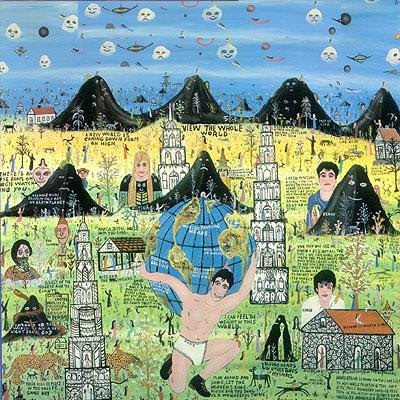
5. Those of you who are itching to say who painted this cover, and to mention the other 1980s album cover also painted by him, may certainly do so. I'd be itching too.


6.


Submit your answers in the comments accompanied by what will, in retrospect, seem like a too-enthusiastic use of newly-available sythesizers and electronic percussion.

Thursday, May 21, 2009

On the Town With the 5000s

Molly Gloss/Ursula LeGuin

Last week was the Friends of the Library annual meeting, and boy oh boy did we have awesome speakers this year. We had Molly Gloss, who mostly writes books set in the frontier West but whom I know from her science fiction novel The Dazzle of Day (which I discussed here). I was nominally her “personal assistant” for the evening, which mostly involved pestering her for a book signing once during the reception. She was very gracious about my admission that I think of her book not as "The Dazzle of Day," but as “Quakers in Space!” “I get that a lot,” she said.

Appearing with her on the program was her friend Ursula K. LeGuin, probably the City of Roses’ most famous author and, for my money, one of the greatest voices in American fiction. I got to meet her and shake her hand and everything! And ask a question that she dismissed as naïve! It was awesome.


Mike Doughty

We had to blow out early, though, because we had tickets to a Mike Doughty show over at the new Mississippi Studios. While we were making our exit, another Friends director who is considerably younger than me could not contain his amazement. “You’re going to a concert that starts at TEN?” he asked, pronouncing the word “ten” as if it signified truly rare daring-do. “That’s just the way they roll,” someone else answered for us, and the magnificent feeling of being young-for-our-age lasted until we arrived at the venue and the doorman joked about how he didn’t need to card the two of US, obviously.

Mr. Doughty is a terrific songwriter and a highly entertaining showman, and he is touring in a two-man setup with his buddy Scrap playing bass lines and accompaniment on a cello. Stripped-down arrangements generally work really well when songs are well-crafted, and that was certainly true in this case. We whooped it up until – hang onto your hats, now – well after midnight. Afterwards, we got to meet the man and make a few sentences of inane fan conversation while buying a live CD, Busking, that he recorded in the New York subway tunnels. It is awesome for good performances, for the ambient noise of trains and passers by, and for the conspicuous lack of response that street musicians have to endure at the end of every song. I highly recommend you go out and get a copy…. but you can’t. It’s only for sale at the shows. Sorry, man.


Portland Columbia Symphony

The week before last, we caught the season closer for the Portland Columbia Symphony. The program featured Smetana’s warhorse “The Moldau,” which was appallingly beautiful in live performance, as well as Mahler’s “Songs of the Wayfarer,” which had some minor balance problems but otherwise came off very nicely indeed. The third piece was my least favorite Dvorak symphony, the 8th, which was given a rich, warm performance that reaffirmed that the worst Dvorak is better than the best of most other composers out there.

We continue to not only really dig the great sound and performances of the PCS, but also how close you can get to them, and frankly for how little money. We already have tickets to three shows for next season, for which we will be able to sit as close as we want, for about as much as it would cost to go to a single Oregon Symphony concert and sit so high up you need supplemental oxygen. The second weekend in October, they’ve got Sibelius’ Second on the docket, as well as the Fourth Beethoven Piano Concerto. Awesome!
photos cheerfully nicked from other bloggers who apparently thought to bring cameras

Saturday, May 16, 2009

Weekend Flashback: A Decemberists' Tale

The original version of this post appeared on August 23, 2007.

At the recent Family5000 Reunion, Niece #2 went out shopping and came back with a copy of the concert video The Decemberists: A Practical Handbook.

And really, that's a pretty good story right there. Because YOUR nieces probably listen to, what? The latest crippy-crap Brittney Spears clone that Central Marketing has mandated as this year's teen sensation? Or, if you're lucky, thug hiphop lite? Well, MY neices listen to the Decemberists. Envy me.

Anyway: Nieces #1-3 troop off to screen the video. But then, Niece #1 reappears almost immediately to tell me I better come take a look at this. So I follow her upstairs.

In the screening room, my brother-in-law solemnly restarts the video.

I see the following:

  • The opening shot: the Roseland Theater's sign reflected in a mud puddle.
  • The second shot: the Roseland Theater sign, right side up.
  • The third shot: A caption reading "The Roseland Theater, Portland, Oregon, November 2005"
  • And then, the surprising fourth shot: Myself and Mrs. 5000.
Granted, we are seen at the beginning of a pan across the crowd. We are two people among many. But, we are easily the most prominent people in the shot. We are visible for litterally seconds.

Now, it must be said that several times during the reunion, my nieces witnessed me doing things that were not only solidly adult, but arguably quite square. For example, I was visibly excited to receive a water filtration system as a birthday gift. I demonstrated concern about safety on several occasions. I may have discussed property values. I occasionally used the word "square."

Given this kind of thing, and yet that one always hopes for some quirky-but-maybe-kind-of-cool-uncle cred with the nieces, it certainly can't hurt to show up in their rock videos.

---

Back here in 2009, I'm putting this post together while listening to the new Decemberists' album, The Hazards of Love. You likely either already know about it, or don't give a damn. For the record, though, it is growing on me almost immediately despite its proggy indulgences.

Tuesday, February 24, 2009

New Music: A Survey


There's no counting the number of bands that employ retro guitar, scruffy production values, and a sense of detached irony, but World Festival of Youth and Students throws in a soaring soprano vocal line that takes the band into a territory all its on. On their sophomore outing, I Am the Person I Know Best, World Festival bring a fresh energy to songs about family relationships, living in a media-saturated culture, and the sometimes alienating lifestyle of the travelling professional musician.


Miracle Girls can be relied to deliver a cheerful, jangling sort of antidote to radio pop music, and they do not let us down on To Hate His Friends, their fourth effort. The songs are connected with a loose theme of how it's better to be single than attached, although it's not clear whether this was planned or is just a natural result of the Miracle Girls' way of thinking. The title track is pretty funny; the album closer "Home, Office, Home, Office, Grave" is, despite the title, one of the funniest songs I've heard this year.


for other people is the gloomiest record yet for Athens, Georgia based Gomishan City. Filled with brooding rock meditations on death and longing -- think Bob Mould meets The Smiths -- this record is packed with the kind of music you love to feel bad to.


Murder At the Windmill's ...in a pinstripe suit is a low-fi song cycle about the decline, decay, and possibly the death (it's all very ambiguous) of a stereotypical high-powered businessman. Halfway between the classic Tom Waits album Frank's Wild Years and some kind of strange bluegrass dirge, this is the kind of record that seems at first merely bizarre, but then quickly gets under your skin if you let it.


The oddly-named Charles P. Steinmetz Academic Center are a Scottish quintet whose music features textured, brooding electronic soundscapes underlaying vigorous acoustic-guitar driven pop tunes. Steinmetz, the lead singer, has a terrific tenor, soaring up into a bold falsetto on "What One Has to Do," the title track of their third album.


You would not expect a woman with the stage name of "Oswald Pornbacher" to record conventional songs. Her new album "as quickly as possible" might well be named "as quirkily as possible," as odd instruments, time signatures, lyrics, and tempos bounce around almost, but not quite, at random. People who like songs to end in predictable ways may be made uncomfortable.


History of Nunuvut continues to produce noisy, quirky college rock, jangly guitars and vocal harmonies underlain with a rich cello line. Frightened of the Old Ones refers not to the band's own musical history -- fans will find this new album instantly familiar -- but to a series of old girlfriends, described to hilarious effect in the title track.


Gunthorpe, Nottinghamshire is not for everyone. With a blasting attack powered by no less than three heavily distorted electric guitars, G.N. has been fairly accused of being musically sloppy. On their new record, Whatever Your Task May Be, there is evidence of improving songcraft in there under the noisy assault.


Sythesizer-driven prog rock that could have fallen straight out of the mid-70s, USS Luckenbach nevertheless seem to be right at home in the current musical landscape. If they are at times a bit bombastic, it is great pretension to dance to. On Reason Shines But Dimly they are once again cerebral and virtuosic, but not too much so for their own good.


Crystal Palace emerges from a five-year drought with what at first listen sounds like an especially boisterous house party. Listening closely to the lyrics under the rich textures -- I'm pretty sure I hear oboes and bagpipes in there -- reveals a darker side to the album. Many of these rollicking, uptempo songs are about grief, about loss of illusions and loss of faith. Not often are the dark and the light of human existence -- Unbridled Joy and Nothing at All, indeed -- so beautifully combined in pop music.


Also recommended, especially for anyone puzzled about any of the above: The new Motorins album, Southern efficiency and Northern charm.

Sunday, February 22, 2009

The Monday Quiz LXIII

Rock: the 1960s

The 1960s was when the greatest rock music ever made was being made, at least if you are a fan of the rock music of the 1960s! Hum your favorite Beatles tunes to yourself as you identify the following rock artists of that great decade.

1. Who is this gentleman?


2. Who are these young lads?


3. How come... No, wait. The question is: Who are these guys?


4. Who are these fellows? Careful, now....

5. And: Identify either these guys....

...or these guys.


Submit your answers in the comments with a blast of guitar distortion presaging the hard rock of the 1970s.